




Ablution
(Wudu Tayammum and Ghusl)
Simple Guide to Ablution
Before prayer, the believer purifies themselves according to their situation: with water (wudu), or, if water is unavailable, by performing dry ablution (tayammum).
How to Perform Ablution (Wudu) ?
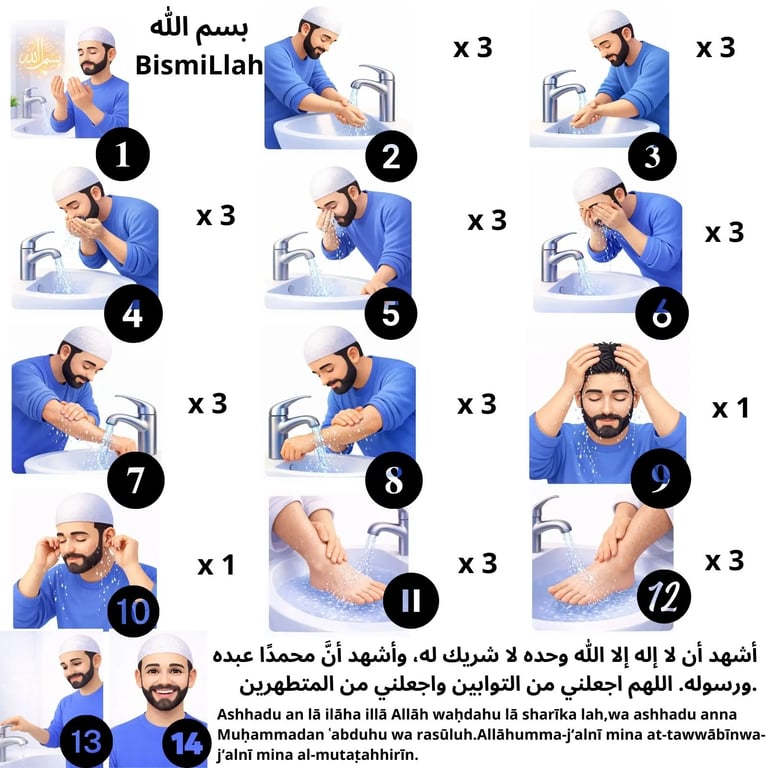
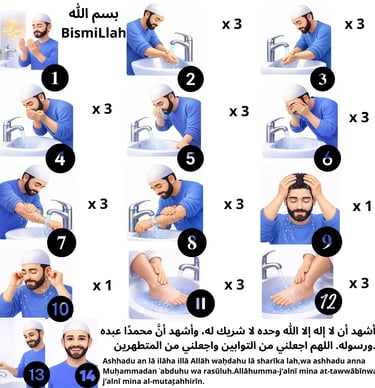
Step-by-step simplified guide to performing water ablution before prayer.
How to Perform Dry Ablution (Tayammum)?
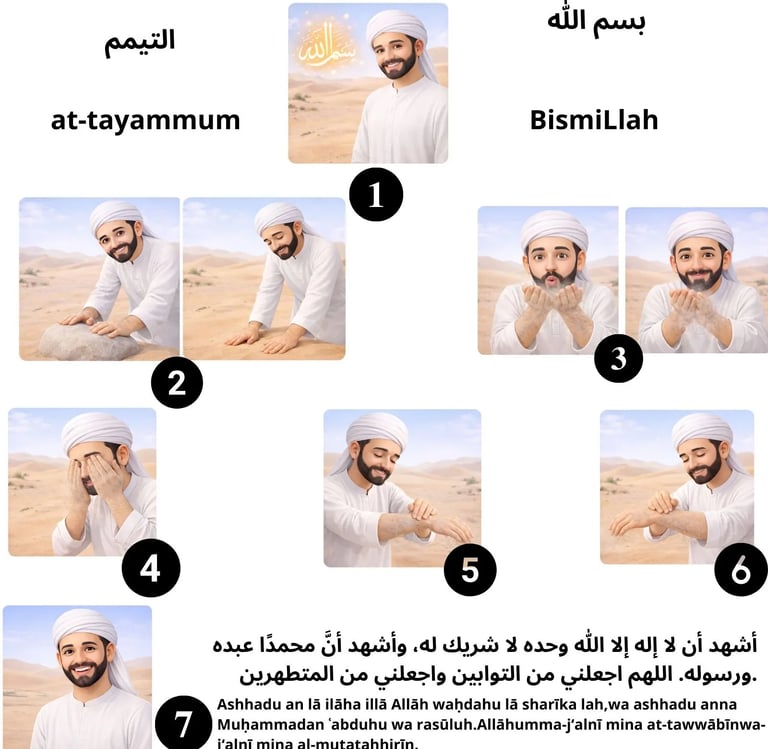
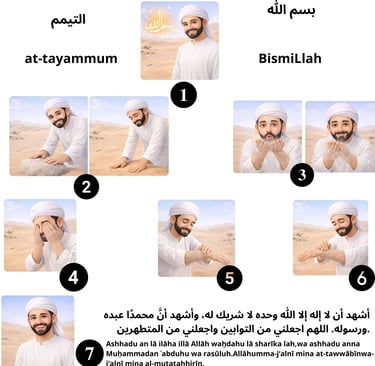
Simplified guide for when water is not available or cannot be used.
Does the Shahada have a place in ablution (wudu)?
Yes. Ablution (wudu) ends with the Shahada, followed by a supplication. This reminds us that physical purification is completed by a testimony of faith and a spiritual elevation of the heart toward Allah.
Ablution (Wudu): Definition
Ablution (wuḍūʾ) is the ritual purification with water that a believer performs before prayer.
It consists of washing specific parts of the body in a precise order, with the intention of preparing to stand before Allah.
Wudu is not merely an act of hygiene:
it is a spiritual preparation for worship.
How to Perform Ablution (Wuḍūʾ)
Ablution is performed in a precise order, with the intention of preparing oneself to perform the prayer.
The following images and text show each step of ablution (wudu).
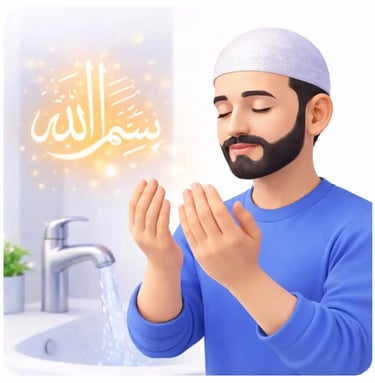
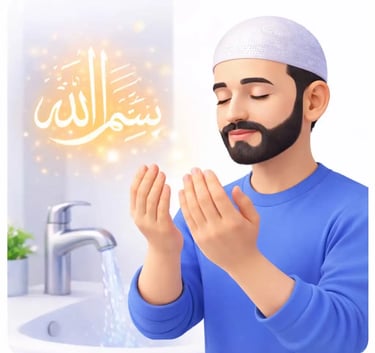
Make the intention in your heart.
Say: BismiLlāh.
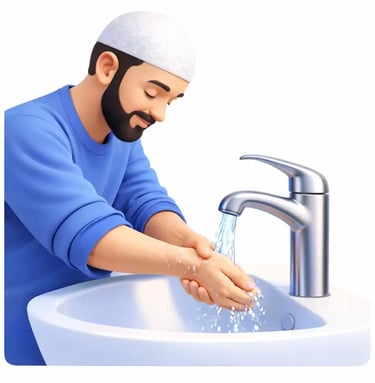
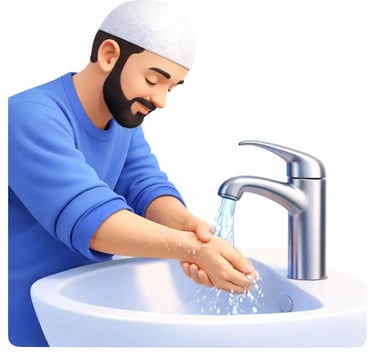
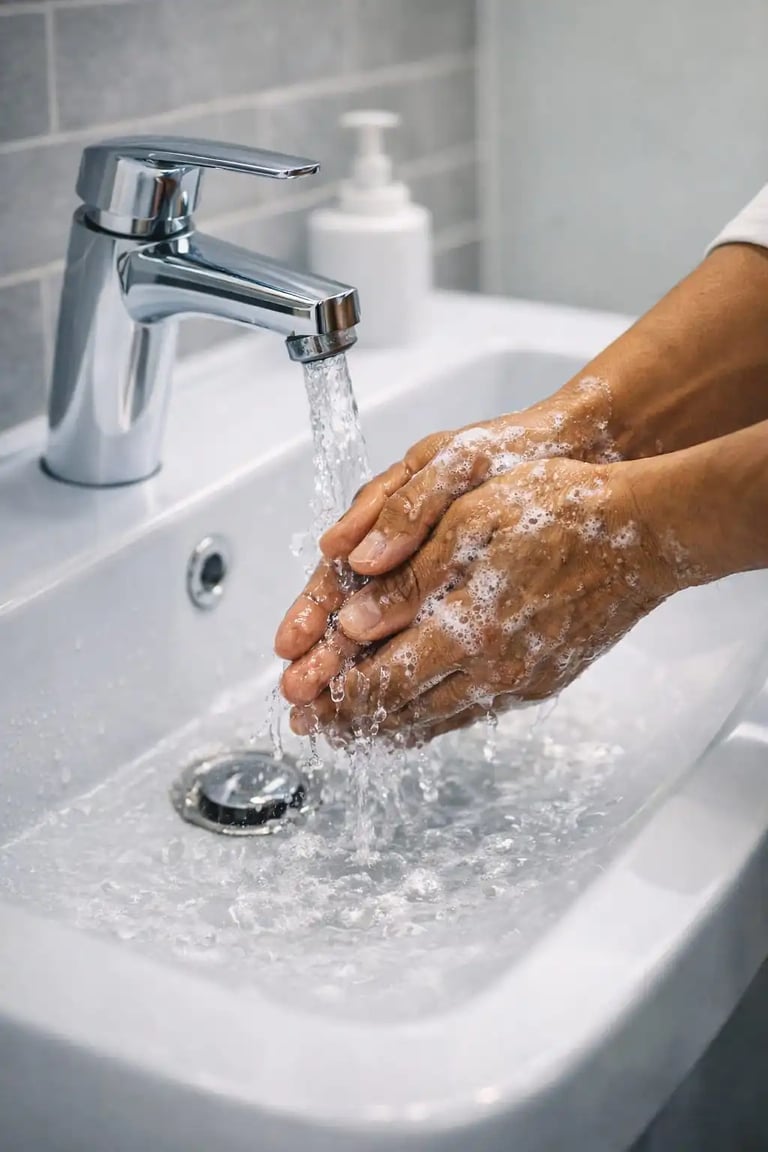
Wash the right hand
3 times
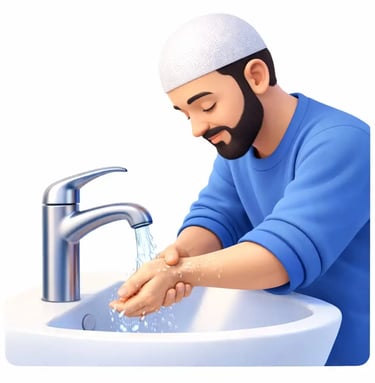
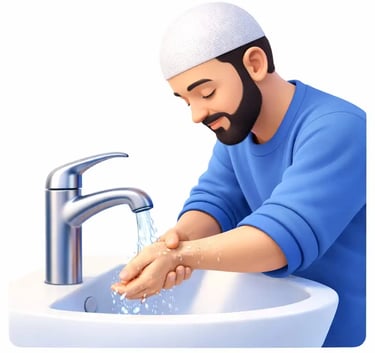
Wash the left hand
3 times
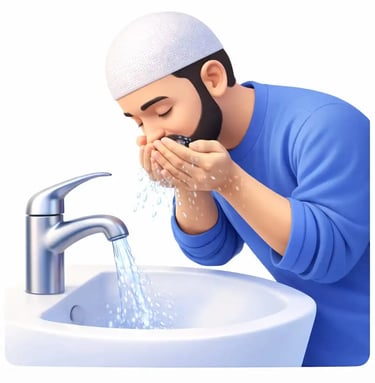
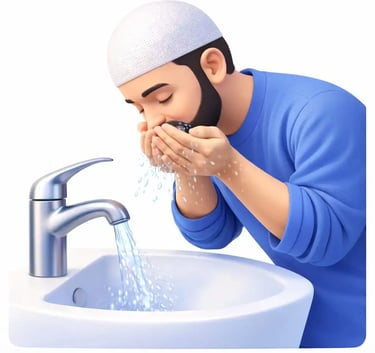
Rinse the mouth
3 times
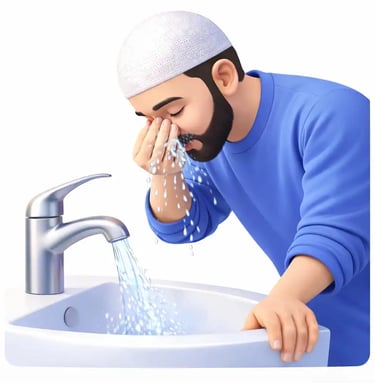
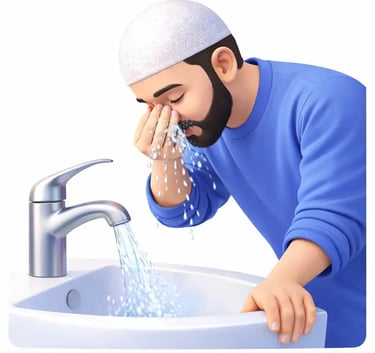
Rinse the nose
(gently inhale water, then blow it out)
3 times
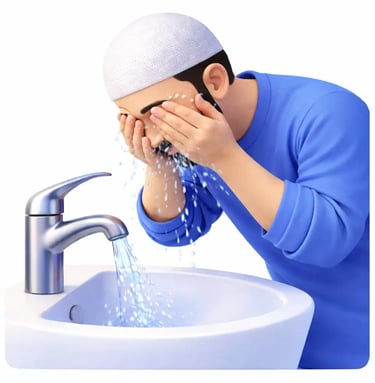
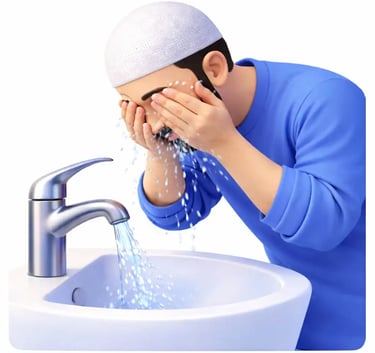
Wash the face
(from the forehead to the chin, from ear to ear)
3 times
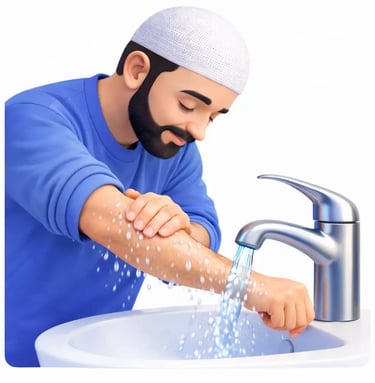
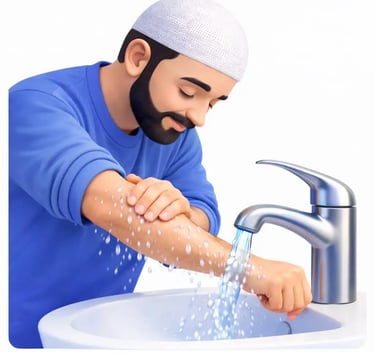
Wash the right arm up to the elbow
3 times
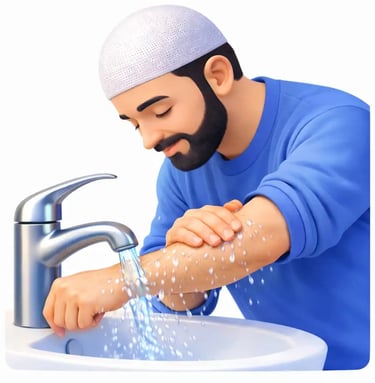
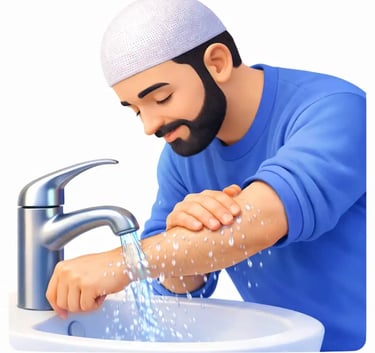
Wash the left arm up to the elbow
3 times
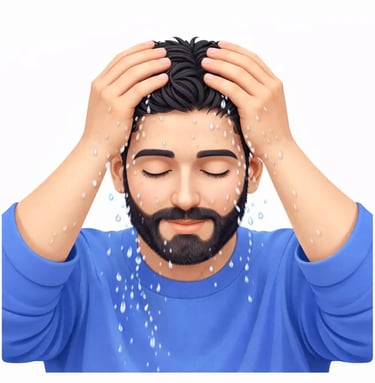
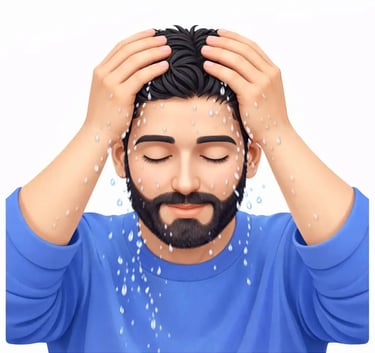
Wipe over the head with wet hands:
place your hands at the front of the head,slide them to the back of the neck,then return them to the front (one back-and-forth).
1 time


Wipe the ears with the remaining moisture
(inside with the index fingers, outside with the thumbs)
1 time
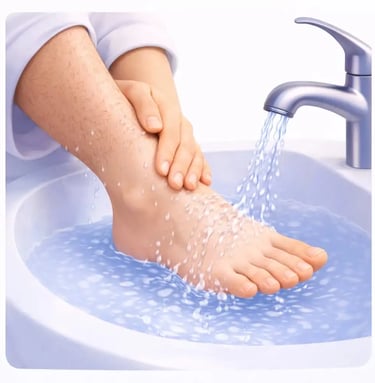
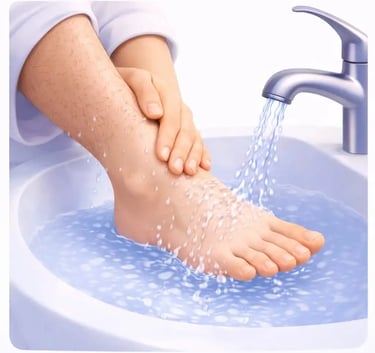
Wash the right foot up to the ankle
3 times
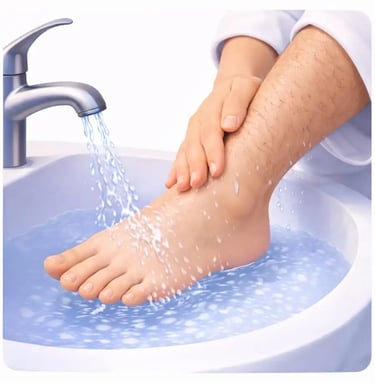
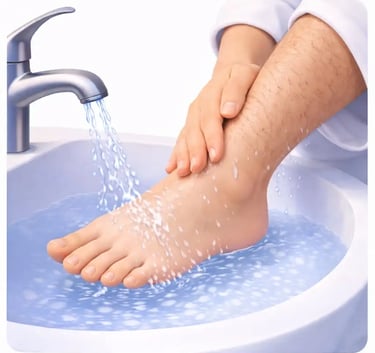
Wash the left foot up to the ankle
3 times


Do not waste water.
This step is explained in detail further down the page.


Recite the supplication:
Ashhadu an lā ilāha illā Allāh waḥdahu lā sharīka lah,wa ashhadu anna Muḥammadan ʿabduhu wa rasūluh.Allāhumma-j‘alnī mina at-tawwābīnwa-j‘alnī mina al-mutaṭahhirīn.
This step is explained in detail further down the page.
Moderation in the Use of Water
(Do not waste water)
Wudu is an act of worship, but it is performed with simplicity and restraint.
The Prophet Muḥammad, peace and blessings of Allah be upon him, once saw Saʿd ibn Abī Waqqāṣ using a large amount of water for his ablution and said:
“What is this waste, O Saʿd?”
Saʿd replied:
“Is there waste even in the water used for ablution?”
He answered:
“Yes, even if you are at the edge of a river.”
(Ibn Mājah, Aḥmad — ḥasan)
This hadith reminds us that purity is not achieved through excess.
Even in worship, Islam teaches moderation, respect, and balance.
Thus, the believer purifies the body
without waste,
without excess,
within an ethic of responsibility and awareness.
The Shahada After Ablution
At the end of ablution, the believer does not stop at being outwardly pure.
This physical purification is completed by a declaration of faith.
The Prophet Muḥammad, peace and blessings of Allah be upon him, taught that after wudu, the believer recites the Shahada, followed by a supplication that unites the body, the heart, and faith.
What is said after ablutions
I bear witness that there is no deity worthy of worship except Allah, alone, without partner,
and I bear witness that Muḥammad is His servant and His Messenger.
O Allah, make me among those who repent,
and make me among those who purify themselves.
Transliteration:
Ashhadu an lā ilāha illā Allāh waḥdahu lā sharīka lah,
wa ashhadu anna Muḥammadan ʿabduhu wa rasūluh.
Allāhumma-j‘alnī mina at-tawwābīn
wa-j‘alnī mina al-mutaṭahhirīn.
In Arabic:
أَشْهَدُ أَنْ لَا إِلَٰهَ إِلَّا اللَّهُ وَحْدَهُ لَا شَرِيكَ لَهُ،
وَأَشْهَدُ أَنَّ مُحَمَّدًا عَبْدُهُ وَرَسُولُهُ.
اللَّهُمَّ اجْعَلْنِي مِنَ التَّوَّابِينَ،
وَاجْعَلْنِي مِنَ الْمُتَطَهِّرِينَ.
Meaning
Water purifies the body.
The Shahada purifies the intention.
The supplication directs the heart.
Thus, every ablution becomes a quiet renewal of faith.
The believer does not only prepare to pray:
he bears witness once again, even before standing before Allah.
And each wudu is a step further towards Islam.
Dry Ablution (Tayammum): Definition
Dry ablution (tayammum) is a form of ritual purification without water, performed when a believer is unable to use water.
It is done using clean earth or a natural, pure surface, with the intention of preparing for prayer.
In such cases, tayammum replaces ablution with water or the full ritual bath when necessary.
Tayammum is not a simple symbolic gesture:
it is a mercy from Allah, allowing the believer to never be deprived of worship.
Does the Shahada Have a Place in Dry Ablution (Tayammum)?
Yes. Dry ablution (tayammum) also ends with the Shahada, followed by a supplication.
Even without water, this purification concludes with a testimony of faith, reminding us that tayammum is not a simple physical gesture, but an act of worship.
Thus, just as with wudu, the purification of the body is completed by the elevation of the heart toward Allah and by the affirmation of the oneness of Allah.
How to Perform Dry Ablution (Tayammum)?
Dry ablution is performed in a simple and precise order, with the intention of preparing oneself to perform the prayer.
The following images and text show each step of dry ablution.


Make the intention in your heart.
Say: BismiLlāh.
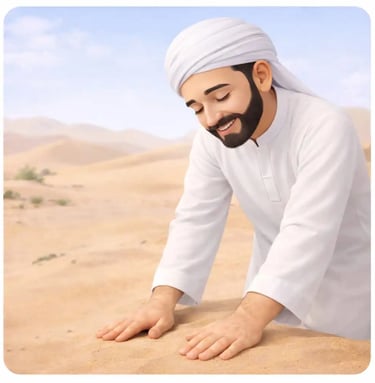
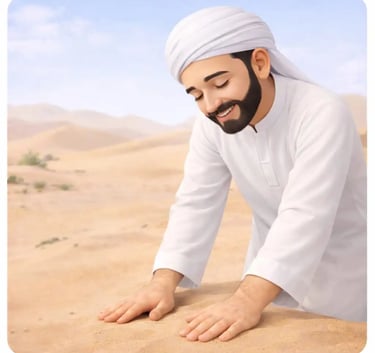
Place both hands on clean earth
(natural dust, sand, a clean stone, a natural wall, etc.)
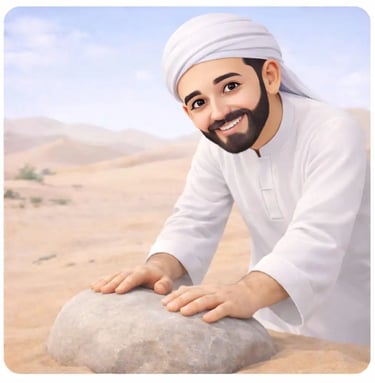
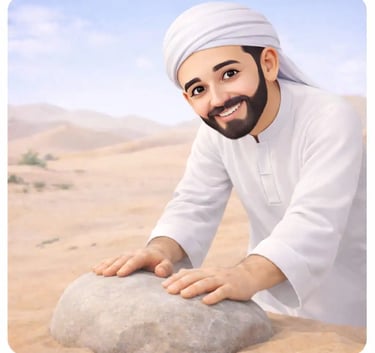
or


Lightly tap your hands or blow on them to remove excess dust.


or
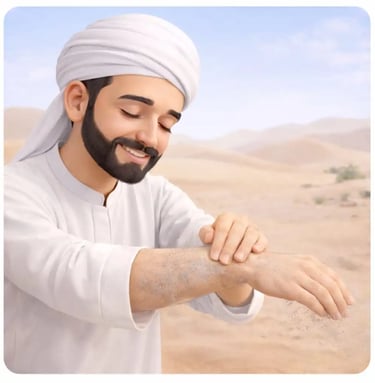
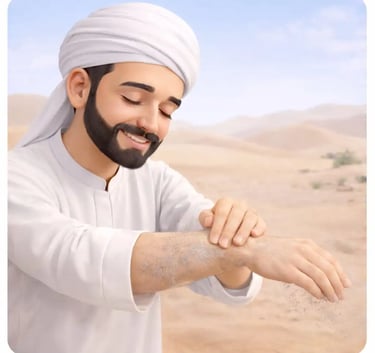
Wipe the right hand up to the wrist or up to the elbow depending on the school.


Wipe the left hand up to the wrist — or up to the elbow depending on the school.
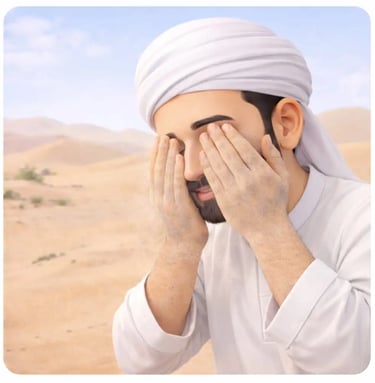
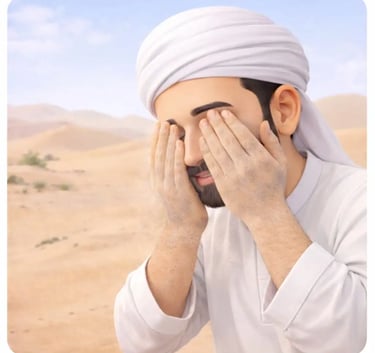
Wipe both hands over the face once
(from the forehead to the chin, from ear to ear).


Recite the supplication:
Ashhadu an lā ilāha illā Allāh waḥdahu lā sharīka lah,wa ashhadu anna Muḥammadan ʿabduhu wa rasūluh.Allāhumma-j‘alnī mina at-tawwābīnwa-j‘alnī mina al-mutaṭahhirīn.
This step is explained in detail higher up on the page.
Sources :
Sahih al-Bukhari
Sahih Muslim
ʿAmmār ibn Yāsir (may Allah be pleased with him) said:
The Prophet Muhammad, peace and blessings of Allah be upon him, sent me on an errand. I became in a state of major impurity and could not find water, so I rolled in the dust as an animal rolls. Then I came to the Prophet Muhammad, peace and blessings of Allah be upon him, and mentioned that to him.
He said:
“It would have been enough for you to do like this.”
Then the Prophet Muhammad, peace and blessings of Allah be upon him, struck the earth with his two hands one single strike, then wiped his left hand over the right, the back of both hands, and his face.
Major Ablution (Ghusl): Definition
In certain situations, it is required to perform major ablution (ghusl), which consists of washing the entire body with the intention of returning to a state of ritual purity, in particular:
after marital relations,
after the end of menstruation or postnatal bleeding,
after a state of major impurity.
The Complete Method of Performing Ghusl
Ghusl is performed with the intention of purifying oneself for worship.
Form the intention in your heart
(to purify yourself from a state of major impurity in order to pray).
Say: BismiLlāh.
Wash the hands:
right hand 3 times,
then left hand 3 times.
Wash the private parts with the left hand
(to remove any impurity).
Then wash the left hand.
Perform a complete wudu, as for prayer
(the feet may be washed at the end if you are in a wet area).
Pour water over the head:
ensure the water reaches the scalp,
massage the head with the fingers,
pour water 3 times, making sure the roots of the hair are fully wet.
Wash the entire body:
begin with the right side,
then the left side,
making sure water reaches every part of the body:
armpits, navel, skin folds, behind the knees, between the toes, etc.
If the feet were not washed during wudu,
wash them now:
right foot,
then left foot.
At this point, ghusl is complete, and the person is in a state of full ritual purity.
To Remember
Even if someone does not follow this order perfectly,
as long as water truly reaches the entire body with the intention of purification,
the ghusl remains valid.
What is presented here is the perfect form of ghusl,
as taught by the Prophet Muḥammad, peace and blessings of Allah be upon him.lui.
Hadiths
Hadith 1
The Prophet Muḥammad, peace and blessings of Allah be upon him, said:
“Whoever performs ablution perfectly and then says:
‘I bear witness that there is no deity worthy of worship except Allah, alone, without partner,
and I bear witness that Muḥammad is His servant and His Messenger,’
the eight gates of Paradise are opened for him;
he may enter through whichever one he wishes.”
(Muslim — ṣaḥīḥ)
Hadith 2
“When a Muslim servant performs ablution and washes his face,
every sin committed by his eyes leaves with the water — or with the last drop of water.
When he washes his hands,
every sin committed by his hands leaves with the water — or with the last drop of water.
When he washes his feet,
every sin committed by his feet leaves with the water — or with the last drop of water,
until he emerges purified from his sins.”
(Muslim — ṣaḥīḥ)
Hadith 3
“Whoever performs ablution and then says:
‘I bear witness that there is no deity worthy of worship except Allah,
and I bear witness that Muḥammad is the Messenger of Allah.
O Allah, make me among those who repent
and make me among those who purify themselves,’
it will be said to him:
‘Enter through whichever gate of Paradise you wish.’”
(At-Tirmidhī — ḥasan ṣaḥīḥ)
These texts show that wudu is not a simple act of cleansing.
It is a true purification, followed by a living testimony of faith.
Supplication (Duʿāʾ)
O Allah,
just as You purify our bodies with water,
purify our hearts with faith.
Make every ablution for us
a return to You,
an erasing of our faults,
and a sincere renewal of our testimony.
Grant us presence of heart
when we pronounce the Shahada,
and allow us to stand before You
with hearts that are alive and humble.
O Allah, send Your prayers and blessings upon
the Prophet Muḥammad,
as well as upon his family and his Companions.
By Your mercy,
make us among those who repent
and among those who purify themselves.
Āmīn
Navigation Help
You can click on each image below to explore the different pages.
Say BismiLlāh and enjoy the journey.













The First Words
The forms of the Shahada
The index finger in the Shahada
The Shahada in the Qur’an
Entering Islam
The Shahada in Prayer
In the believer’s life
Sincerity of the Heart
Miracle
The supreme rank of the Shahada


The Forms of the Tashahhud in Prayer


Purification : Ablution


The Shahada in the Call to Prayer
Prayer
Time
Home



The Last Word

