




Fasting the 6 Days of Shawwal: Virtues, Rules, and Calculation of the Reward
In summary
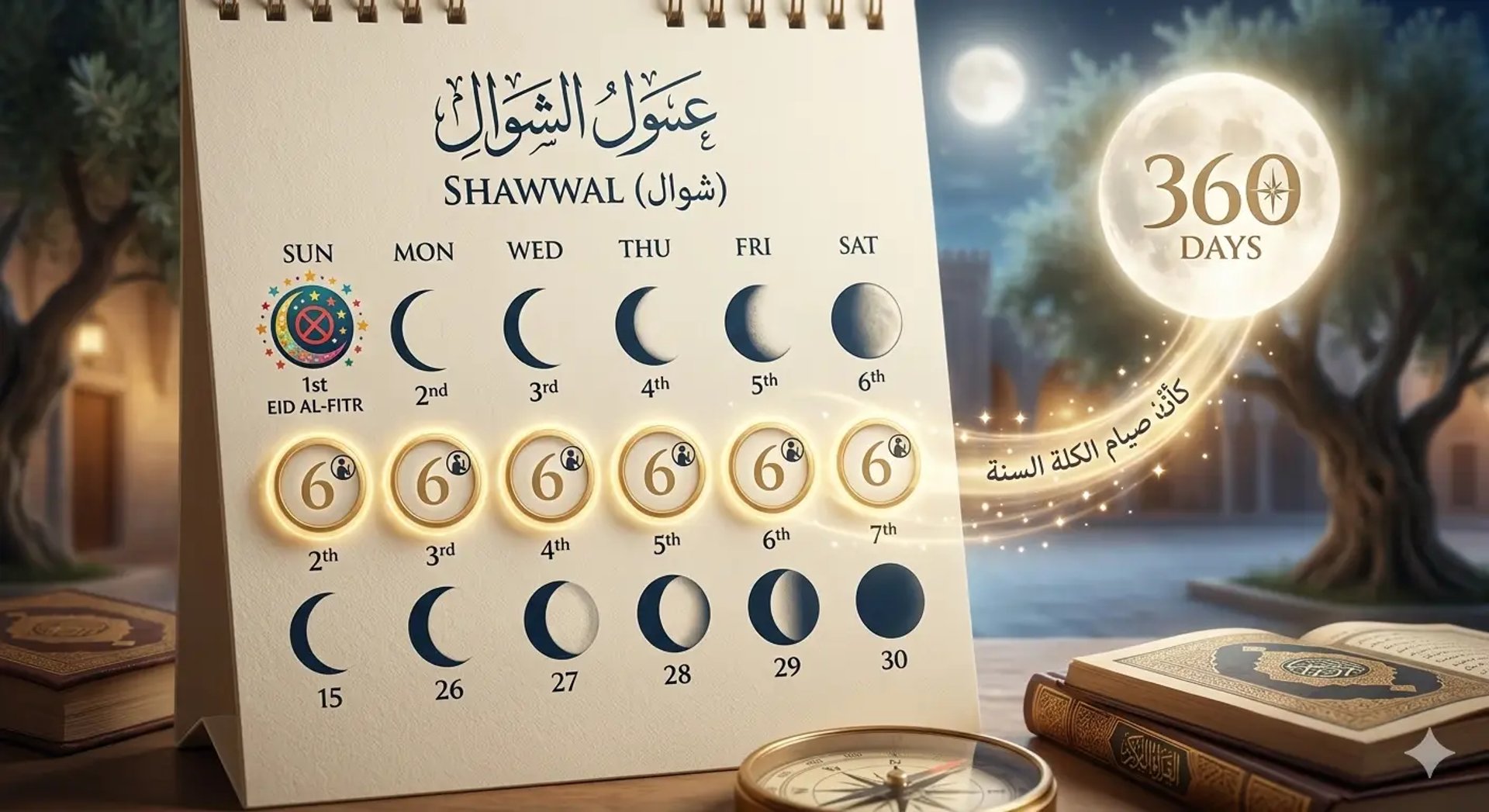
Date of Eid: 1 Shawwal (fasting is forbidden)
Recommended fasting: six days during the month of Shawwal
Reward: as if one had fasted the entire year
Organization: consecutive days or separate days
Hadith: reported by Muslim
What is the month of Shawwal?
Meaning :
Shawwal (شوال) is the tenth month of the Islamic calendar.
It comes immediately after the month of Ramadan.
Like all months in the Islamic calendar, it begins with the sighting of the crescent moon.
The first day of Shawwal marks the celebration called Eid al-Fitr, the festival of breaking the fast.
Eid al-Fitr: the 1st of Shawwal
Eid al-Fitr is celebrated on the first day of the month of Shawwal.
This date is determined by the sighting of the crescent moon that marks the end of Ramadan and the beginning of Shawwal.
The exact date may therefore vary depending on the region.
The six days of fasting in Shawwal
After Ramadan, it is recommended to fast six days during the month of Shawwal.
Abu Ayyub al-Ansari reported that the Prophet Muhammad, peace and blessings of Allah be upon him, said:
“Whoever fasts the month of Ramadan and then follows it with six days of Shawwal, it is as if he fasted the entire year.”
Authentic hadith reported by Muslim.
Why is fasting for the six days of Shawwal equivalent to a whole year of fasting?
In Islam, a good deed is rewarded at least ten times.
Ramadan:
30 days × 10 = 300 days
Six days of Shawwal:
6 days × 10 = 60 days
Total:
360 days
Therefore, whoever fasts Ramaḍān and then follows it with six days of Shawwal receives a reward equivalent to fasting an entire year.
Scholars explain that this corresponds to what classical texts call Ṣiyām al-Dahr (صيام الدهر), meaning fasting for a whole year.
The rule for fasting the six days of Shawwal
The six days may be observed:
in succession, for example from the 2nd to the 7th of Shawwal
or spread throughout the month
Both ways are permitted.
The important thing is to complete six days of fasting during the month of Shawwal.
The day of Eid: fasting is forbidden
The six days may be observed:
The first day of Shawwal, the day of Eid al-Fitr, is a day on which fasting is forbidden.
Abu Sa'id al-Khudri reported:
“The Prophet Muhammad, peace and blessings of Allah be upon him, forbade fasting on two days: the day of Eid al-Fitr and the day of Eid al-Adha.”
Authentic hadith reported by al-Bukhari and Muslim.
This day is a day of:
prayer
gratitude
joy
sharing
Zakat al-Fitr
Before the Eid prayer, Muslims must give Zakat al-Fitr.
This obligatory charity serves to:
purify the fasting of Ramadan
help people in need
allow everyone to celebrate Eid
It must be given before the Eid prayer.
Abdullah ibn Umar reported:
“The Messenger of Allah, peace and blessings of Allah be upon him, made Zakat al-Fitr obligatory at the end of Ramadan for the people: one sa‘ of dates or one sa‘ of barley for the slave and the free, for the male and the female, for the young and the old among the Muslims, and he ordered that it be given before the people go out for the prayer.”
Authentic hadith reported by al-Bukhari and Muslim.
Intention (Niyyah)
Like every act of worship, fasting the six days of Shawwal must be done with a sincere intention (niyyah).
The intention is made in the heart before the beginning of the fast.
Some people ask whether it is possible to combine the intention of making up missed days of Ramadan with the intention of the six days of Shawwal.
Scholars have different opinions on this issue. Many recommend distinguishing the intentions in order to obtain the full reward mentioned in the hadith.
Frequently asked questions
Can the six days start immediately after Eid?
Yes.
The six days can begin starting from the 2nd of Shawwal, because the 1st of Shawwal (the day of Eid) is a day on which fasting is forbidden.
Can one fast the six days of Shawwal if they still need to make up missed days of Ramadan?
Two opinions exist among scholars:
some say that one should first make up the missed days of Ramadan
others say that one may fast the six days and then make up the missed days later
In all cases, the missed days of Ramadan must be made up before the next Ramadan.
Can the six days be spread throughout the month?
Yes.
The six days may be fasted:
consecutively
or separately
at any time during the month of Shawwal.
The 12 months of the Islamic calendar
Muharram
Safar
Rabi al-Awwal
Rabi ath-Thani
Jumada al-Ula
Jumada ath-Thaniyah
Rajab
Sha'ban
Ramadan
Shawwal
Dhu al-Qa'dah
Dhu al-Hijjah
The Islamic calendar is a lunar calendar of 12 months based on the observation of the moon.
Sources
Sahih Muslim
Sahih al-Bukhari
Hadith about the six days of Shawwal — reported by Muslim
Hadith about the prohibition of fasting on the days of Eid — reported by al-Bukhari and Muslim.
Navigation Help
You can click on each image below to explore the different pages.
Say BismiLlāh and enjoy the journey.



















The First Words
The forms of the Shahada
The index finger in the Shahada
The Shahada in the Qur’an
Entering Islam
The Shahada in Prayer
In the believer’s life
Sincerity of the Heart
Miracle
The supreme rank of the Shahada


The Forms of the Tashahhud in Prayer


Purification : Ablution


The Shahada in the Call to Prayer


Prayer
Time
Home




The Last Word

