



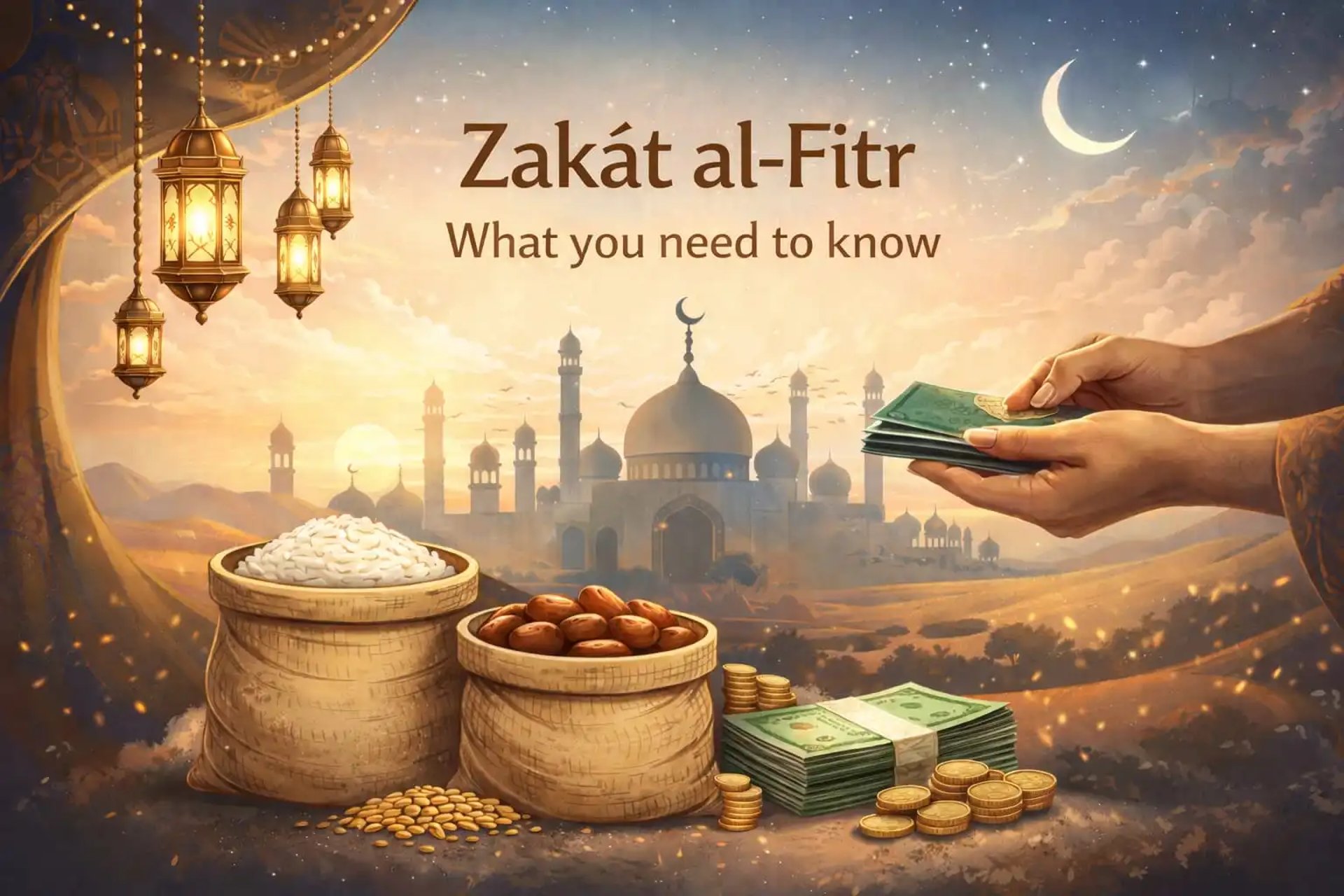
Zakat al-Fitr: What You Need to Know
For those who cannot give Zakat al-Fitr
Before anything else, we extend a sincere thought and our full support to those who are going through hardship and living in need.
May Allah grant them ease, dignity, and abundant provision.
Islam is a religion of ease and mercy.
If a person does not have the means to give Zakat al-Fitr, then it is not required from them.
Allah never asks a soul to bear more than it can handle.
May Allah grant those who are in difficulty provision, peace, and open for them the doors of ease.
Invocation
اللَّهُمَّ أَغْنِ الفُقَرَاءَ مِنْ فَضْلِكَ
وَارْزُقْهُمْ رِزْقًا وَاسِعًا حَلَالًا
وَافْتَحْ لَهُمْ أَبْوَابَ رَحْمَتِكَ
Allāhumma aghni al-fuqarā’a min faḍlika
wa-rzuqhum rizqan wāsiʿan ḥalālan
wa-ftaḥ lahum abwāba raḥmatika
O Allah, enrich the poor by Your grace,
grant them abundant and lawful provision,
and open for them the doors of Your mercy.
What is Zakat al-Fitr: definition
Zakat al-Fitr is a mandatory charity for Muslims at the end of the month of Ramadan. It must be given before the Eid al-Fitr prayer so that people in need can also celebrate the festival with dignity. This charity purifies the fast of the month of Ramadan and strengthens solidarity and mutual support within the community.
Islam is built upon five fundamental pillars: the Shahada, the testimony of faith; the Salat, the prayer; the Zakat, the obligatory annual charity on wealth; the Sawm, the fasting during the month of Ramadan; and the Hajj, the pilgrimage to Mecca for those who are able. Zakat al-Fitr is different from the Zakat that constitutes one of these pillars. It is a specific charity related to the end of Ramadan and must be given for each member of the household before the Eid prayer.
The Prophet Muhammad, peace and blessings of Allah be upon him, made this charity obligatory in order to purify the fast and help the poor. It is reported in an authentic hadith:
Ibn Abbas said:
“The Messenger of Allah made Zakat al-Fitr obligatory as a purification for the fasting person from idle and indecent speech, and as food for the poor. Whoever gives it before the Eid prayer, it is accepted as Zakat; and whoever gives it after the prayer, it is simply a charity among charities.”
— reported by Abu Dawud and Ibn Majah.
This practice also reflects the spirit of solidarity encouraged by the Quran. Allah says:
“Take from their wealth a charity by which you purify them and increase them in blessing, and invoke blessings upon them. Indeed, your prayer is reassurance for them. And Allah is All-Hearing, All-Knowing.”
— Surah At-Tawbah, verse 103.
Difference between Zakat and Zakat al-Fitr
Zakat is one of the five pillars of Islam. It is an obligatory annual charity taken from certain types of wealth when they reach a threshold known as the nisab. It represents a fundamental act of purification of wealth and social justice within the community. Allah says in the Quran:
“Establish prayer and give Zakat, and whatever good you send forward for yourselves, you will find it with Allah. Indeed, Allah sees perfectly what you do.”
— Surah Al-Baqarah, verse 110.
Zakat al-Fitr, however, is not a pillar of Islam. It is a mandatory charity specifically connected to the end of the month of Ramadan. Its amount traditionally corresponds to a measure of staple food, given for each member of the household, in order to allow the poorest members of society to share in the joy of Eid. The Prophet Muhammad, peace and blessings of Allah be upon him, also emphasized its importance in a hadith reported by Abdullah ibn Umar:
“The Messenger of Allah made Zakat al-Fitr obligatory: one sa‘ of dates or one sa‘ of barley for every Muslim, slave or free, male or female, young or old. He ordered that it be given before people go out for the Eid prayer.”
— reported by Al-Bukhari and Muslim.
Thus, Zakat purifies the wealth of the believer and constitutes a fundamental pillar of Islam, while Zakat al-Fitr purifies the fast of Ramadan and ensures that the celebration of Eid is shared by everyone, including those in need.
Who must give Zakat al-Fitr?
Zakat al-Fitr is obligatory for every Muslim who possesses more than their essential needs on the day and night of Eid.
The head of the household may give it on behalf of:
himself
his wife
his children
those who are under his responsibility
When should Zakat al-Fitr be given?
Zakat al-Fitr must be given before the Eid prayer.
It is permissible to give it one or two days before Eid in order to facilitate its distribution to people in need.
If it is given after the Eid prayer, it is considered a simple charity and no longer Zakat al-Fitr.
How much is Zakat al-Fitr in 2026?
What amount should be given for Zakat al-Fitr?
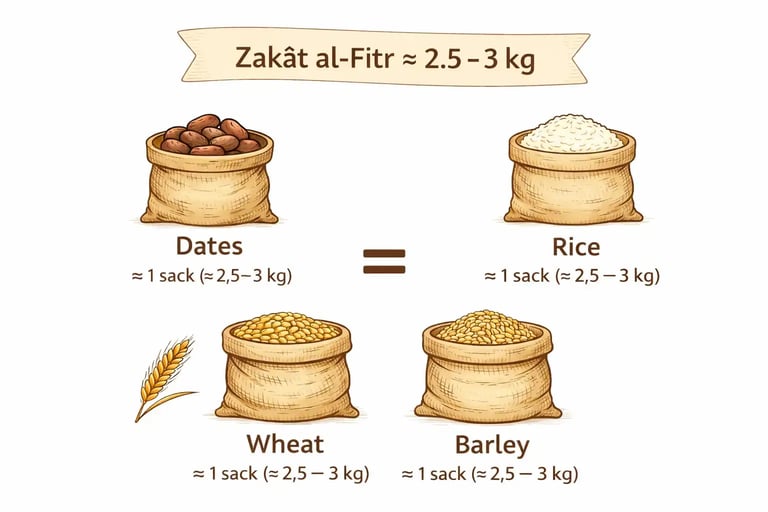
Traditionally, Zakat al-Fitr corresponds to one saʿ of food, which is approximately 2.5 to 3 kg of a staple food, such as:
wheat
rice
dates
barley
or another staple food of the country
Today, in many countries, Zakat al-Fitr is often given in the form of money, in order to facilitate its collection and distribution to people in need.
The amount may therefore vary depending on the country, the price of food, and the guidance provided by local mosques or charitable organizations.
Can Zakat al-Fitr be given in money? Giving Zakat al-Fitr in food or in money
Islamic scholars have discussed the way Zakat al-Fitr should be given: should it be given in food, or can it be given in money?
Many scholars, including those of the Maliki, Shafi‘i, and Hanbali schools, consider that Zakat al-Fitr should be given in the form of food, in accordance with the practice of the Prophet Muhammad, peace and blessings of Allah be upon him, and his companions.
ʿAbdullah ibn Umar reported:
“The Messenger of Allah made Zakat al-Fitr obligatory: one sa‘ of dates or one sa‘ of barley for every Muslim, slave or free, male or female, young or old. He ordered that it be given before people go out for the Eid prayer.”
— reported by Al-Bukhari and Muslim.
This is also the dominant practice in certain countries, particularly in Saudi Arabia, where Zakat al-Fitr is often distributed directly in the form of food.
Other scholars, particularly within the Hanafi school, have allowed it to be given in money when it is more beneficial for people in need. In many countries today, this practice has become common in order to facilitate collection and distribution.
Whatever the form chosen, the objective remains the same: to provide real help to people in need and allow them to share in the joy of Eid.
It is also important to remember that assistance should be adapted to the real situation of the person receiving it. Giving food is a noble practice and strongly encouraged, but it is also important to consider the living conditions of the person in need. For example, if someone receives a bag of rice but does not have a pot, gas, or any means to cook, that food may not be immediately usable. The essential point is therefore to provide help that can truly be used and benefit the person receiving it.
The Quran also encourages believers to give from what they love:
“You will never attain true righteousness until you spend from that which you love. And whatever you spend, Allah is fully aware of it.”
— Surah Aal Imran, verse 92.
The spirit of solidarity and meeting those in need
Zakat al-Fitr is not limited to a simple transfer of goods. It is also an opportunity to strengthen human connections and solidarity within the community.
For those who have the possibility, meeting people in need can be a deeply human experience. A smile, a kind word, or a gesture of respect can sometimes have an immense impact.
It may happen that a person who is financially comfortable can share useful knowledge with someone going through difficulty: advice, a skill, or guidance toward a job or training. Such knowledge can sometimes allow a person to escape poverty permanently.
But the opposite can also occur: a poor person may share a word of wisdom, a reminder, or sincere advice that protects the one who listens and benefits them for their entire life.
In Islam, the dignity of a person in need is deeply respected. The Prophet Muhammad, peace and blessings of Allah be upon him, said:
“Beware of the supplication of the oppressed, for there is no barrier between it and Allah.”
— reported by Al-Bukhari and Muslim.
The supplication of someone in hardship therefore holds a special place with Allah.
For this reason, encounters with people facing hardship must always be approached with respect, kindness, and sincerity.
Why present an estimated table
We chose to present the table and calculator below as a practical tool that may be useful in different situations.
Some people live in isolated regions or remote villages where it is not always easy to obtain precise information. Others may be unable to travel due to health issues, distance, or personal circumstances. The table can also help those who simply wish to know the estimated equivalent in their country, or understand what the obligation of Zakat al-Fitr represents in practical terms.
It can also be useful for people who are curious and wish to know the equivalent of this charity across different countries and income levels, in order to better understand the reality of this obligation.
In many places, mosques and charitable organizations also collect Zakat al-Fitr in order to distribute it in an organized way to people in need.
This table therefore does not replace the guidance provided locally, but it can help each person estimate the corresponding amount in their country and fulfill this obligation in the best possible way.
But beyond the amounts and calculations, what truly matters remains the sincere intention, the generosity of the heart, and the genuine desire to help those in need.
Who should I give Zakat al-Fitr to?
Zakat al-Fitr should be given to people in need so that they can also take part in the joy of Eid.
Among the possible recipients:
the poor
people facing financial hardship
families in need
The meaning of Zakat al-Fitr
Zakat al-Fitr has several objectives:
to purify the fast of Ramadan
to help people in need
to strengthen solidarity among Muslims
to allow everyone to celebrate Eid with dignity
Conclusion
Zakat al-Fitr has several objectives:
to purify the fast of Ramadan
to help people in need
to strengthen solidarity among Muslims
to allow everyone to celebrate Eid with dignity
Navigation Help
You can click on each image below to explore the different pages.
Say BismiLlāh and enjoy the journey.

















The First Words
The forms of the Shahada
The index finger in the Shahada
The Shahada in the Qur’an
Entering Islam
The Shahada in Prayer
In the believer’s life
Sincerity of the Heart
Miracle
The supreme rank of the Shahada


The Forms of the Tashahhud in Prayer


Purification : Ablution


The Shahada in the Call to Prayer


Prayer
Time
Home




The Last Word

