




How to Say, Formulate, and Pronounce the Shahada?
The Shahada is not confined to a single wording.
It exists in several authentic and recognized forms within the Islamic tradition.
All of them are correct.
All of them are true.
None contradict the others.
They express the same faith, through different formulations, according to context.
The three forms presented here have been chosen because they correspond to the most widespread usages and to essential moments of spiritual life.
Other authentic formulations of the Shahada also exist in the sources, depending on context and transmission.
All of them proceed from the same truth and express the same belief.
For each form, an audio recording is provided so that the pronunciation may be heard as it is transmitted in the tradition.
These voices do not replace the intention of the heart.
They help one hear, learn, and respect the accuracy of the words.
1) The first form of the Shahada presented here
This is an essential form — one that concentrates the whole faith into a single phrase.
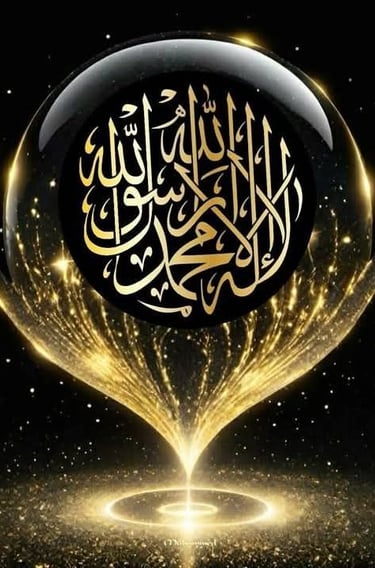
لَا إِلٰهَ إِلَّا اللَّهُ، مُحَمَّدٌ رَسُولُ اللَّهِ
Lā ilāha illā Allāh, Muḥammad Rasūl Allāh
Translation
“There is no deity except Allah; Muḥammad is the Messenger of Allah.”
Context
This formula is not a simple verbal declaration.
It constitutes the founding act of Islam.
Through it, a person consciously affirms the absolute Oneness of Allah and recognizes the mission of the Prophet Muḥammad, peace and blessings of Allah be upon him, as the authentic transmission of this truth.
This testimony has also become, throughout history, a public symbol of Islam, to the point of being inscribed on certain flags of Muslim countries, where it explicitly expresses the religious foundation upon which their identity rests.
The Shahada is therefore not an introductory formula,
but the foundation upon which all faith rests,
and the criterion by which Islam is affirmed, lived, and preserved.
How should the shahada be pronounced in this version?
You can listen to it in the video below.
2) The second form of the Shahada presented here
This is the complete and attested form of the testimony, as it is transmitted in the sources.
أَشْهَدُ أَنْ لَا إِلٰهَ إِلَّا اللَّه
وَأَشْهَدُ أَنَّ مُحَمَّدًا رَسُولُ اللَّهِ
Ashhadu an lā ilāha illā Allāh
wa ashhadu anna Muḥammadan Rasūl Allāh
Translation
“I bear witness that there is no deity except Allah, and I bear witness that Muḥammad is the Messenger of Allah.”
Context
This formulation of the Shahada is the one pronounced upon entering Islam.
It appears in the accounts of the earliest conversions and in the teaching of the Prophet Muḥammad, peace and blessings of Allah be upon him.
It is also proclaimed daily in the call to prayer (adhān), where it is repeated publicly to remind everyone of the foundation of the Islamic faith.
Here, it is not merely a matter of stating a true sentence.
One bears witness.
The word ashhadu — “I bear witness” — transforms the statement into a conscious inner act.
It is no longer only a correct affirmation about God and about the Prophet.
It becomes a personal commitment, expressed with full awareness.
This is the Shahada of encounter:
the moment when faith is recognized, assumed, and affirmed by the person themselves.
How should the shahada be pronounced in this version?
You can listen to it in the video below.
3) The third form of the Shahada presented here
This is an extended form, corresponding to the wording used in the tashahhud.
أَشْهَدُ أَنْ لَا إِلٰهَ إِلَّا اللَّهُ وَحْدَهُ لَا شَرِيكَ لَهُ
وَأَشْهَدُ أَنَّ مُحَمَّدًا عَبْدُهُ وَرَسُولُهُ
Ashhadu an lā ilāha illā Allāh waḥdahu lā sharīka lah
wa ashhadu anna Muḥammadan ʿabduhu wa rasūluh
Translation
“I bear witness that there is no deity except Allah, alone, without partner, and I bear witness that Muḥammad is His servant and His Messenger.”
Context
This formulation belongs to the authentic expressions of the Shahada used in prayer.
All of its elements are firmly rooted in the Qur’an and the Sunnah: – “Alone, without partner” affirms the absolute Oneness of Allah. – “His servant and His Messenger” corresponds to the formulation transmitted by the Prophet Muḥammad, peace and blessings of Allah be upon him, himself, notably in the teaching of the tashahhud.
This formulation reminds that the prophetic mission is founded upon servitude to Allah, without exaggeration or diminution.
This Shahada is recited in the seated position of the prayer (tashahhud) and is part of the salutations and the prayer upon the Prophet (the Ibrāhīm salutations).
It is not the minimal formula for entering Islam.
It does not replace the other forms of the Shahada, but expresses the same faith with more explicit terms, within the most intimate moment of worship.
When it is recited in prayer, it becomes the Shahada lived, affirmed before Allah in the very act of worship.
How should the shahada be pronounced in this version?
You can listen to it in the video below.
These forms are all legislated and may be used in different circumstances:in prayer, to enter Islam, in the tashahhud, or at various moments in life as a reminder.
What matters most is how you feel, your sincerity, and the benefit you receive when you say them.
Allah wants ease for you.
✦
Invocation (Dua)
O Allah, You who are One and whose truth never changes,
let our words be in harmony with our hearts.
Grant us to pronounce the Shahada with sincerity,
awareness, and respect,
in all of its legislated forms.
Make each testimony for us
a living reminder of Your Oneness
and of the mission of Your Messenger.
Protect us from recitation without presence,
and grant us a faith that enlightens our words
and guides our actions.
Make our testimonies
true words carried by living hearts,
and let them be a witness in our favor
on the Day of Judgment.
Āmīn.
Navigation Help
You can click on each image below to explore the different pages.
Say BismiLlāh and enjoy the journey.












The First Words
The forms of the Shahada
The index finger in the Shahada
The Shahada in the Qur’an
Entering Islam
The Shahada in Prayer
In the believer’s life
Sincerity of the Heart
Miracle
The supreme rank of the Shahada


The Forms of the Tashahhud in Prayer


Purification : Ablution


The Shahada in the Call to Prayer


Prayer
Time
Home




The Last Word

