




Everything you need to know about Ramadan 2026:
Meaning, Obligations and Spirituality
Direct: Check the Ramadan 2026 calendar and dates here
The month of Ramadan 2026 is a sacred time of devotion, sharing, and fasting for Muslims around the world. Whether you want to understand the spiritual meaning of this fourth pillar of Islam or the practical rules of fasting, this complete guide accompanies you throughout this blessed month.
Ramadan definition
Ramadan is the ninth month of the Islamic lunar calendar.
It is the fourth pillar of Islam.
During this month, Muslims fast each day from dawn until sunset with the intention of worshiping Allah, inner purification, and spiritual remembrance.
The fast includes abstaining from food, drink, and marital relations during the daytime, accompanied by ethical conduct: patience, restraint, sincerity, and remembrance of Allah.
What is the spiritual meaning of Ramadan?
Ramadan is a month devoted to worship of Allah, purification of the heart, and reform of behavior. Through fasting, the believer learns patience, self-control, and sincerity in worship. He distances himself from distractions to draw closer to the Qur’an, supplication, and prayer.
This month also reminds human beings of their dependence upon their Lord and develops compassion toward the needy, leading to the attainment of piety (taqwa).
The rules of fasting: Who must fast and how?
Fasting Ramadan is obligatory for every Muslim who has reached puberty, is of sound mind, and is physically able to fast. It consists of abstaining from food, drink, and marital relations from dawn until sunset with the intention of worshiping Allah.
The traveler and the sick person are temporarily excused and must later make up the missed days. A person permanently unable to fast feeds one poor person for each missed day. A woman during menstruation or post-natal bleeding does not fast and makes up the days later.
Beyond physical abstention, fasting also involves restraint of the gaze, the tongue, and behavior: avoiding lies, insults, and injustice so that fasting becomes an act of piety rather than mere deprivation.
The benefits of patience and piety (Taqwa)
Fasting trains the soul in patience and self-control. By voluntarily abandoning what is normally permitted, the believer learns to resist desires and direct his behavior toward obedience to Allah. This inner discipline develops piety (taqwa), which means living with constant awareness of Allah in both visible and hidden actions.
Over the days, the heart softens, gratitude increases, and the relationship with the Qur’an intensifies. Fasting reminds one of human fragility and encourages generosity toward the needy. Thus Ramadan becomes a time of personal reform where patience, forgiveness, and sincerity are strengthened in the believer’s life.
Laylat al-Qadr 2026: The importance of the Night of Decree
A night better than a thousand months
Laylat al-Qadr is a night of immense spiritual value during which the Qur’an was revealed. Allah, Exalted is He, says:
“The Night of Decree is better than a thousand months.”
(Surah Al-Qadr, verse 3)
Acts of worship performed during this night are worth more than those performed over many years. It is a privileged moment to seek forgiveness, multiply supplications, and draw closer to Allah.
When to seek the Night of Decree?
Laylat al-Qadr occurs during the last ten nights of Ramadan, especially on the odd nights: 21st, 23rd, 25th, 27th, and 29th.
In 2026, if Ramadan begins around February 18, this night will approximately fall around mid-March. Allah knows best.
What to do during this night?
Increase supplications
Recite the Qur’an with reflection
Pray during the night
Give charity and show generosity
Engage in seclusion, remembrance, and meditation if possible
This night is a unique opportunity to renew faith and hope for Allah’s forgiveness.
Supplication of Laylat al-Qadr
ʿĀʾisha (may Allah be pleased with her) said:
I said:
“O Messenger of Allah, if I know which night is Laylat al-Qadr, what should I say in it?”
He replied:
اللَّهُمَّ إِنَّكَ عَفُوٌّ تُحِبُّ الْعَفْوَ فَاعْفُ عَنِّي
Transliteration:
Allahumma innaka ʿafuwwun tuḥibbu al-ʿafwa faʿfu ʿannī
Translation:
O Allah, You are Pardoning and You love pardon, so pardon me.
Reported by At-Tirmidhī (ḥasan ṣaḥīḥ).
History of Ramadan
The month of Ramadan is the month in which the Qur’an began to be revealed to the Prophet Muḥammad, peace and blessings of Allah be upon him, by the angel Jibril, peace be upon him.
For this reason, this month is connected to revelation, recitation of the Qur’an, supplications, and night prayers.
During this month, Muslims increase acts of worship: prayer, charity, forgiveness, and reconciliation.
The Tarawih Prayer
Definition:
A voluntary night prayer performed during the nights of Ramadan after the ʿIshā’ prayer.
History:
Tarawih is a night prayer performed during the month of Ramadan.
The Prophet Muḥammad, peace and blessings of Allah be upon him, led it in congregation for a few nights and then stopped leading it so that it would not become a burden upon the believers. After his death, people prayed individually. Later, the people wished to pray together, and ʿUmar ibn al-Khaṭṭāb gathered them behind a single imam to organize the prayer in congregation.
During this prayer, the Qur’an is recited gradually until it is completed over the course of the month.
What is a hizb?
A ḥizb is a fixed portion of the Qur’an, divided to facilitate reading and recitation.
The Qur’an text was distributed into sections of relatively similar length, grouping multiple verses (sometimes across different surahs), allowing organized recitation from beginning to end.
The Qur’an is traditionally divided into 60 ḥizb.
How much to recite per night to finish in 30 nights?
To complete the recitation of the Qur’an in congregational prayer over 30 nights, typically 2 ḥizb are recited each night.
Thus, after 30 nights, the 60 ḥizb have been recited and the Qur’an is completed entirely.
Verses related to Ramadan
Surah Al-Baqarah (2) — verse 183
O you who have believed, fasting has been prescribed for you as it was prescribed for those before you so that you may attain piety.
يَـٰٓأَيُّهَا ٱلَّذِينَ ءَامَنُوا۟ كُتِبَ عَلَيْكُمُ ٱلصِّيَامُ كَمَا كُتِبَ عَلَى ٱلَّذِينَ مِن قَبْلِكُمْ لَعَلَّكُمْ تَتَّقُونَ
Surah Al-Baqarah (2) — verse 184
For a limited number of days. So whoever among you is ill or on a journey must fast an equal number of other days. And upon those who are able to fast only with hardship is a ransom: feeding a poor person. And whoever volunteers good, it is better for him. But fasting is better for you, if you only knew.
أَيَّامًۭا مَّعْدُودَٰتٍۢ ۚ فَمَن كَانَ مِنكُم مَّرِيضًا أَوْ عَلَىٰ سَفَرٍۢ فَعِدَّةٌۭ مِّنْ أَيَّامٍ أُخَرَ ۚ وَعَلَى ٱلَّذِينَ يُطِيقُونَهُۥ فِدْيَةٌۭ طَعَامُ مِسْكِينٍۢ ۖ فَمَن تَطَوَّعَ خَيْرًۭا فَهُوَ خَيْرٌۭ لَّهُۥ ۚ وَأَن تَصُومُوا۟ خَيْرٌۭ لَّكُمْ إِن كُنتُمْ تَعْلَمُونَ
Surah Al-Baqarah (2) — verse 185
The month of Ramadan in which the Qur’an was revealed as guidance for mankind and clear proofs of guidance and criterion. So whoever among you witnesses the month, let him fast it. And whoever is ill or on a journey must fast an equal number of other days. Allah intends ease for you and does not intend hardship for you, and so that you complete the number and glorify Allah for having guided you and that you may be grateful.
شَهْرُ رَمَضَانَ ٱلَّذِىٓ أُنزِلَ فِيهِ ٱلْقُرْءَانُ هُدًۭى لِّلنَّاسِ وَبَيِّنَٰتٍۢ مِّنَ ٱلْهُدَىٰ وَٱلْفُرْقَانِ ۚ فَمَن شَهِدَ مِنكُمُ ٱلشَّهْرَ فَلْيَصُمْهُ ۖ وَمَن كَانَ مَرِيضًا أَوْ عَلَىٰ سَفَرٍۢ فَعِدَّةٌۭ مِّنْ أَيَّامٍ أُخَرَ ۗ يُرِيدُ ٱللَّهُ بِكُمُ ٱلْيُسْرَ وَلَا يُرِيدُ ٱللَّهُ بِكُمُ ٱلْعُسْرَ وَلِتُكْمِلُوا۟ ٱلْعِدَّةَ وَلِتُكَبِّرُوا۟ ٱللَّهَ عَلَىٰ مَا هَدَىٰكُمْ وَلَعَلَّكُمْ تَشْكُرُونَ
Hadiths related to Ramadan
The Prophet Muḥammad, peace and blessings of Allah be upon him, said:
“Whoever fasts the month of Ramadan with faith and seeking reward, his past sins will be forgiven.”
(Sahih — reported by al-Bukhari and Muslim)
The Prophet Muḥammad, peace and blessings of Allah be upon him, said:
“Whoever stands in prayer during the nights of Ramadan with faith and seeking reward, his past sins will be forgiven.”
(Sahih — reported by al-Bukhari and Muslim)
The Prophet Muḥammad, peace and blessings of Allah be upon him, said:
“When Ramadan comes, the gates of Paradise are opened, the gates of Hell are closed, and the devils are chained.”
(Sahih — reported by al-Bukhari and Muslim)
The Prophet Muḥammad, peace and blessings of Allah be upon him, said:
“When the last ten nights of Ramadan began, he tightened his waist-cloth, spent the night in prayer, and woke his family.”
(Sahih — reported by al-Bukhari and Muslim)
The Prophet Muḥammad, peace and blessings of Allah be upon him, said:
“Every deed of the son of Adam is multiplied: a good deed is multiplied from ten to seven hundred times. Allah says: except fasting, for it is for Me and I give its reward. He leaves his desire and his food for Me. Fasting is a shield. The fasting person has two joys: a joy when he breaks his fast and a joy when he meets his Lord. And the smell of the fasting person’s mouth is more pleasant to Allah than the fragrance of musk.”
(Sahih — reported by al-Bukhari and Muslim)
The Prophet Muḥammad, peace and blessings of Allah be upon him, said:
“Fasting is a shield. When one of you is fasting, he should not speak obscenely or behave ignorantly. If someone insults him or tries to fight him, let him say: ‘I am fasting.’”
(Sahih — reported by al-Bukhari and Muslim)
FAQ
How many pillars does Islam have?
Islam has five pillars.
What are the pillars of Islam?
The shahada, prayer, zakat, fasting Ramadan, and pilgrimage.
Why fast Ramadan?
Because it is a command of Allah and a pillar of Islam established in the Qur’an and the Sunnah.
How many days does Ramadan last?
29 or 30 days depending on the moon sighting.
When do we fast during Ramadan?
From dawn until sunset.
Why fast during the day and not at night?
The day is dedicated to restraint and worship, the night to eating and prayers.
Can missed Ramadan days be made up?
Yes, they must be made up later in equal number.
Should a sick person fast?
If fasting endangers the person or risks worsening their health, they should not fast. If Allah grants recovery, the missed days must be made up.
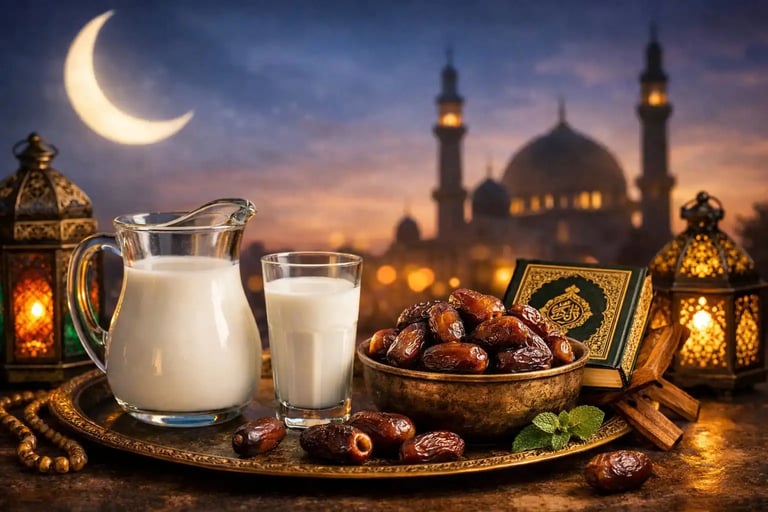
Should dates be eaten to break the fast?
Yes, it is part of the prophetic tradition.
The Prophet Muḥammad, peace and blessings of Allah be upon him, would break his fast with fresh dates before prayer.
If not available, then dry dates.
If not available, then water.
(Sahih — reported by Abu Dawud and At-Tirmidhi)
Eating dates is recommended (sunnah) but not obligatory.
Should milk be drunk to break the fast?
No, drinking milk is not a religious rule.
The authentic sunnah only mentions:
dates
or water
Milk is simply a cultural habit in some countries.
What should be said when breaking the fast?
Arabic:
ذَهَبَ الظَّمَأُ وَابْتَلَّتِ الْعُرُوقُ وَثَبَتَ الْأَجْرُ إِنْ شَاءَ اللَّهُ
Transliteration:
Dhahaba adh-dhama’u wabtallati al-‘urūq wa thabata al-ajr in shā’ Allah
English:
The thirst has gone, the veins are moistened, and the reward is confirmed, if Allah wills.
(Hadith hasan — reported by Abu Dawud)
Access the Guide for Days 1 to 10 (Rules, FAQ and Quran Program)
Supplications
O Allah, forgive our apparent and hidden sins, accept our fasting, our prayer, and our supplications.
O Allah, purify our hearts, improve our character, guide us to what You love and are pleased with.
O Allah, grant healing to the sick, relief to the afflicted, provision to the needy, and peace to the believers.
O Allah, make the Qur’an the light of our hearts, the healing of our chests, and a guide for our lives.
O Allah, grant us sincerity in our deeds, protect us from showing off, and accept from us the little that we do.
O Allah, record us among those freed from the Fire during this blessed month and grant us Al-Firdaws by Your mercy.
SubḥānAllah Rabbī al-ʿAliyy al-Qayyūm
Allāhumma ṣalli wa sallim wa bārik ʿalā Muḥammad wa ʿalā ālihi wa ṣaḥbihi ajmaʿīn
Amin