



Miracle
The Shahada:
Bearing Witness to the Truth
Since the beginning of time, Allah has sent prophets to guide humanity.
Each of them was supported by clear signs and miracles, so their people would recognize that their message truly came from God.
These miracles were visible, tangible, and impressive.
They spoke directly to the eyes of those who were present.
For example, Moses (Mūsā, peace be upon him) was sent to free his people from the oppression of Pharaoh.
As they were being chased and trapped in front of the sea, Allah commanded him to strike the water with his staff.
The sea then split into two, forming a dry path between two immense walls of water, and the believers crossed safely.
It was an extraordinary miracle, obvious to all who witnessed it.
But that event belonged to its time.
Today, no one can witness it directly.
We believe in it through transmitted accounts and trust in the testimonies of the past.
Yes, declaring the Shahada means recognizing the mission of all the prophets of Islam.
Likewise, Jesus (ʿĪsā ibn Maryam, peace be upon him) was also given remarkable miracles.
By Allah’s permission, he walked on water, healed the sick, restored sight to the blind, cured lepers, and brought the dead back to life.
These signs brought hope and confirmed his mission to his people.
Again, these miracles were real and visible to those who lived alongside him.
But over time, they became events of the past, known only through historical transmission.
Thus, the miracles of the earlier prophets all had a natural limit:
they were powerful, but temporary.
They mainly convinced direct witnesses, while later generations had to believe without seeing.
These miracles were therefore questioned by later generations, since they had not witnessed them. This is one of the reasons why Islam and the Qur’an were sent as a book of reminder.
That is why, with the final message addressed to humanity, the miracle took a different form: no longer a one-time event, but a lasting sign, accessible to everyone in every era.
The Miracle of the Last Prophet
When the final messenger was sent to humanity,
the Prophet Muḥammad, peace and blessings of Allah be upon him,
the very nature of the miracle changed.
It was no longer a spectacular event seen only by one generation,
nor a sign limited to a specific place or moment.
The miracle granted to him is of another nature.
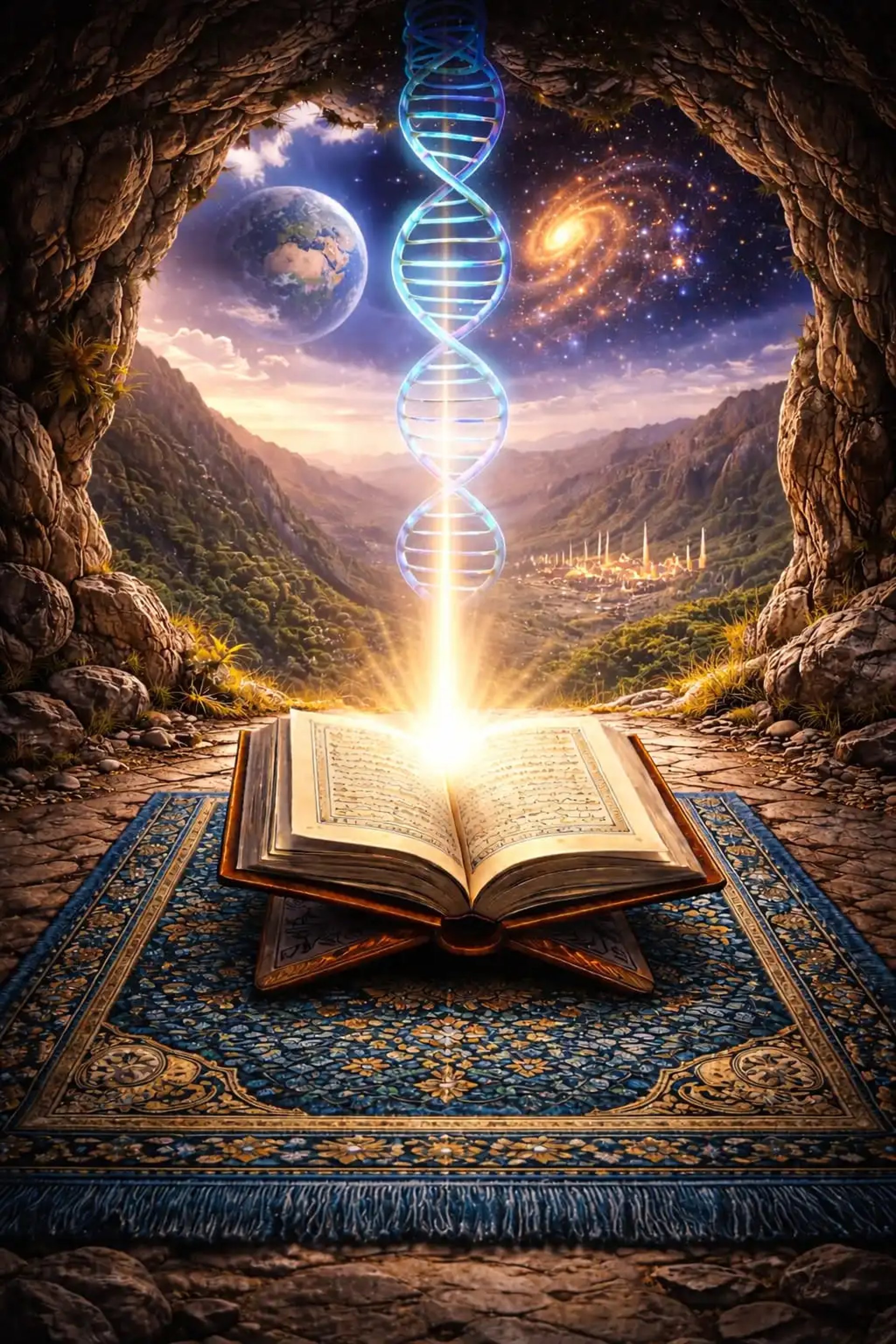
This miracle is a revelation.
It is the
Qur’an.
Unlike the physical miracles of previous prophets, the Qur’an does not disappear with time.
It does not depend on an old story or indirect testimony.
It is always present.
It can be read, heard, studied, memorized, and verified by anyone, even today.
Every generation can access it directly, reflect on its content, analyze its language, meditate on its meanings, and observe its signs.
Thus, the miracle of Islam is not a memory of the past.
It is permanent.
It accompanies humanity in every age.
Where the sea closed again,
where the healings stopped,
the Qur’an remains.
Always alive.
Always preserved.
Always accessible.
That is why it constitutes the ongoing miracle of the last Prophet, a sign intended for all humanity until the end of time.
The Prophet Muḥammad, peace and blessings of Allah be upon him, said:
“Every prophet was given miracles through which people believed in him. As for me, what I have been given is a revelation that Allah revealed to me. So I hope that I will have the most followers on the Day of Resurrection.”
(Authentic hadith reported by al-Bukhārī and Muslim)
Thus, the earlier miracles were temporary. The Qur’an remains. It is always present, recited, learned, studied, and accessible to every generation. Its sign is intellectual, spiritual, and lasting.
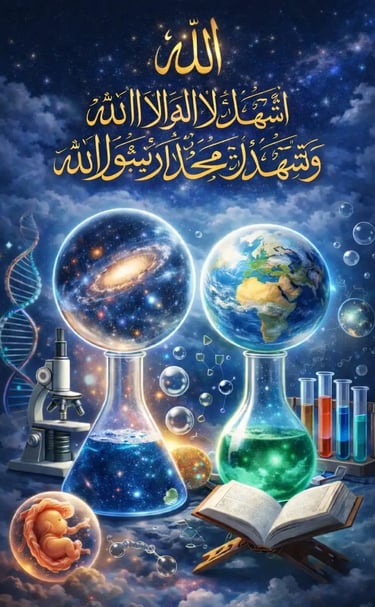
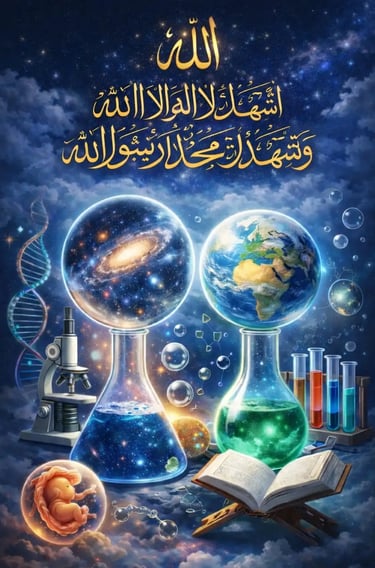
The Qur’an as a Source of Scientific Reflection
The Qur’an frequently draws human attention to natural phenomena. It invites us to observe the heavens, the earth, life, the sea, the human body, and the order of the world. These passages are not formulated as technical theories, but as invitations to reflect, examine, and understand creation.
Thus:
“And the heaven We built with power, and indeed We are expanding it” (51:47) directs reflection toward the vastness, dynamism, and expansion of the universe.
“The heavens and the earth were once a joined mass, then We separated them” (21:30) invites reflection on the origin and organization of the world in light of contemporary theories.
“We made every living thing from water” (21:30) reminds us of the essential role of water in life.
“Then We created the drop… then the clinging substance… then the lump… then the bones which We clothed with flesh” (23:12–14) presents human development as a progressive process consistent with the natural order, encouraging medical research, or at least reflection.
“And the mountains as pegs” (78:7) evokes the stability of the earth and geology.
“He released the two seas, meeting together; between them is a barrier” (55:19–20) refers to real and observable marine phenomena, something difficult to observe from the Arabian desert.
“Each floats in an orbit” (21:33) highlights the order of celestial movements.
“The Romans have been defeated, in the lowest land; but after their defeat, they will be victorious.”30:2–3) This verse refers to a specific historical and geographical reality. Historians generally agree that this battle took place in the Syria–Palestine region, near the Dead Sea. Modern geological measurements have confirmed that this area is one of the lowest exposed land points on Earth, approximately more than 400 meters below sea level. Using contemporary scientific tools and elevation-measuring instruments, this geographical feature can be objectively verified. Thus, the expression “the lowest land” corresponds to a real, measurable geographical fact confirmed by modern geology.
“We sent down iron, in which there is great strength and benefits for people” (57:25). This verse highlights the importance of iron for human civilization. The expression “sent down” may also point to the fact that iron partly comes from space, brought to Earth by meteorites — a scientific reality discovered only recently. Iron is also present in our blood, enabling oxygen transport and making life possible. Thus, this verse invites not only contemplation but also observation and scientific research.
Taken together, these verses form intellectual signposts. They awaken curiosity, stimulate observation, and encourage the study of the real world.
From Revelation to Research
The Prophet Muḥammad, peace and blessings of Allah be upon him, said:
The Prophet Muhammad (peace and blessings be upon him) said: “The superiority of the scholar is like my own superiority over the humblest of you. Indeed, God, His angels, all things in heaven and on earth, even the ants in their anthills and the fish, bless those who teach mankind good. The superiority of the scholar is like the superiority of the moon over all other celestial bodies. Indeed, the scholar is the successor of the prophets, and the inheritance left by the prophets is not wealth, but knowledge. Therefore, whoever inherits knowledge inherits the greatest wealth.”
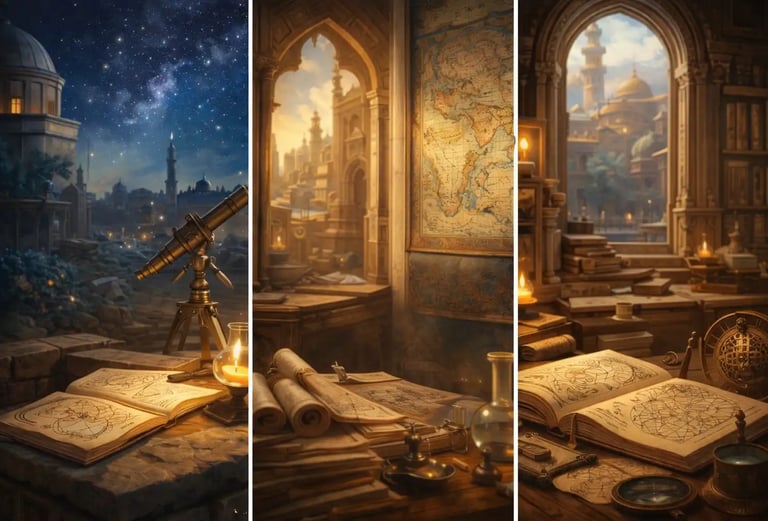
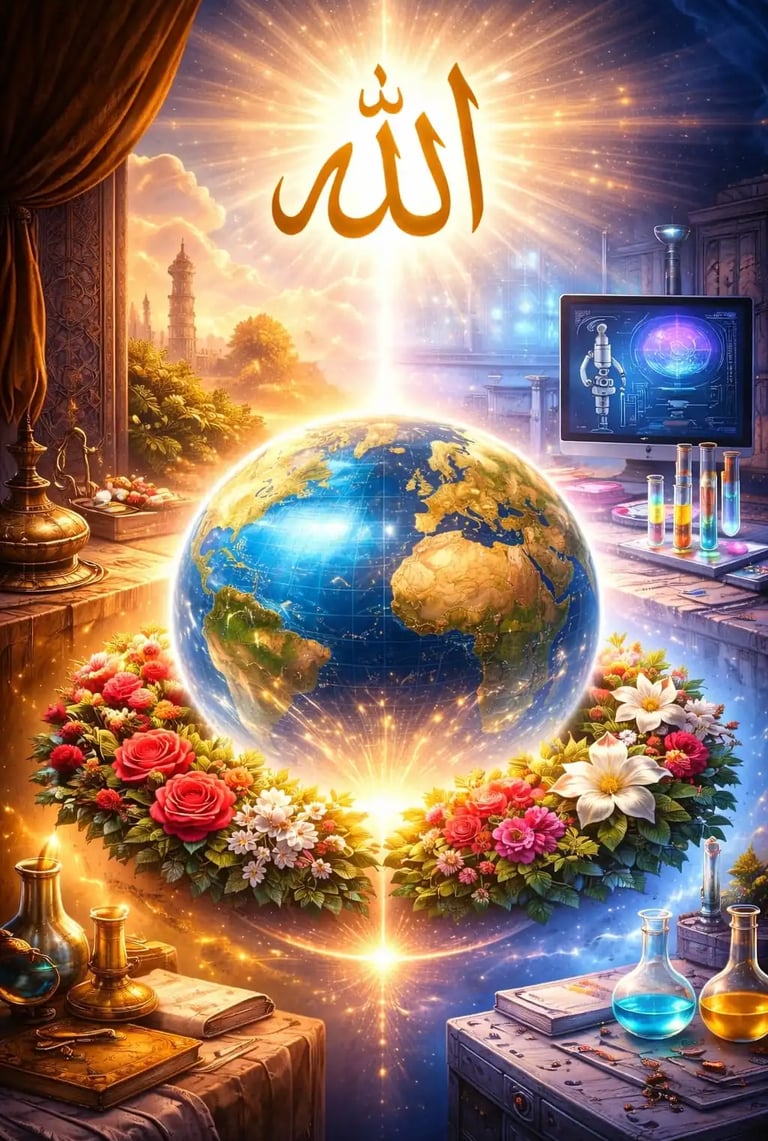
Driven by a religion that highly valued knowledge, Muslim scholars developed specialized sciences based on experimentation, measurement, and practice. Their research led to major technological discoveries still used today.
Avicenna (Ibn Sina): He systematized clinical medicine, accurately described diseases, established systematic diagnostic methods, recognized the contagiousness of certain infections, and emphasized the importance of hygiene, isolation, and water quality. His Canon of Medicine has been a major reference in the medical field for centuries.
Al-Zahrawi: A pioneer in surgery, he described and illustrated more than two hundred surgical instruments, invented absorbable sutures, practiced controlled cauterization, treated fractures and urinary stones, and performed dental and obstetric procedures.
Ibn Haytham: He laid the foundations of experimental methods, demonstrated the role of light in vision, studied lenses and refraction, and established the scientific basis of modern optics.
Al-Biruni: He accurately measured the Earth's radius, conducted cartographic research, and performed reliable astronomical calculations.
Al-Khwarizmi: He systematized algebra and algorithms, thus laying the foundations of modern mathematics and computer science.
These achievements are measurable, verifiable, and remain widely applied in medicine, engineering, optics, and contemporary sciences.
Therefore, this legacy does not belong solely to the past. It reminds us that research, rigor, and practical knowledge are integral to the Muslim intellectual tradition.
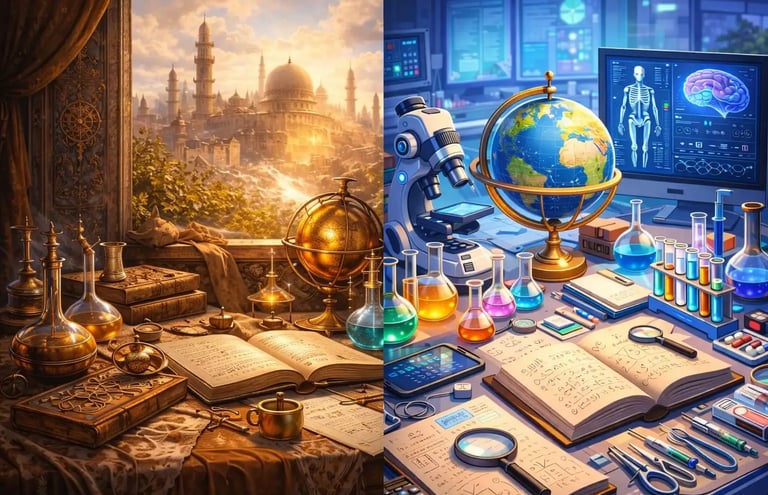
The contemporary world, with its medical, technological, environmental, and human challenges, needs more than ever new scholars, engineers, researchers, doctors, and curious minds capable of combining ethics, science, and responsibility.
There is still room for those who wish to observe, understand, experiment, and improve the real world. The doors are not closed; they are simply waiting to be crossed.


May Allah grant everyone useful, beneficial, lasting knowledge and open the paths of learning.
Surah 20, verse 114
فَتَعَٰلَى ٱللَّهُ ٱلْمَلِكُ ٱلْحَقُّ ۗ وَلَا تَعْجَلْ بِٱلْقُرْءَانِ مِن قَبْلِ أَن يُقْضَىٰٓ إِلَيْكَ وَحْيُهُۥ ۖ وَقُل رَّبِّ زِدْنِى عِلْمًۭا
“So exalted is Allah, the True King. Do not hasten with the Qur’an before its revelation is completed to you, and say:
‘My Lord, increase me in knowledge.’”
Conclusion
The first miracles were visible but temporary.
The final miracle is lasting.
It does not disappear with time.
It awakens intelligence, encourages reflection, and opens the path to knowledge.
Faith bears witness to the truth.
Truth leads to understanding.
Understanding leads to research.
Research produces science.
This is what we can call:
The miracle of science.
Invocation (Dua)
O Allah, grant us useful, sincere, and beneficial knowledge.
Grant us correct understanding, pure intentions, and accepted deeds.
O Allah, increase us in knowledge, wisdom, and discernment.
Protect us from ignorance, arrogance, and knowledge without benefit.
Make us servants who learn, teach, and act for good.
Allow us to be a source of light for others, not a cause of misguidance.
Keep us firm upon the truth until the Day of Judgment.
Grant us a peaceful end and gather us among Your righteous servants.
And grant us the highest level of Paradise, Al-Firdaws, by Your mercy.
Our Lord, increase us in knowledge.
Āmīn
Navigation Help
You can click on each image below to explore the different pages.
Say BismiLlāh and enjoy the journey.







The First Words
The forms of the Shahada
The index finger in the Shahada
The Shahada in the Qur’an
Entering Islam
The Shahada in Prayer
In the believer’s life
Sincerity of the Heart
Miracle
The supreme rank of the Shahada


The Forms of the Tashahhud in Prayer


Purification : Ablution


The Shahada in the Call to Prayer


Prayer
Time
Home
The Last Word

