




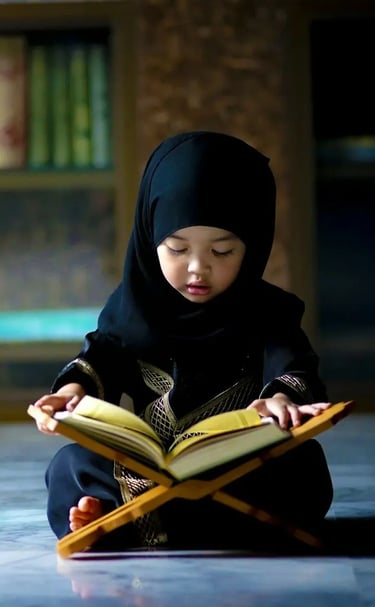
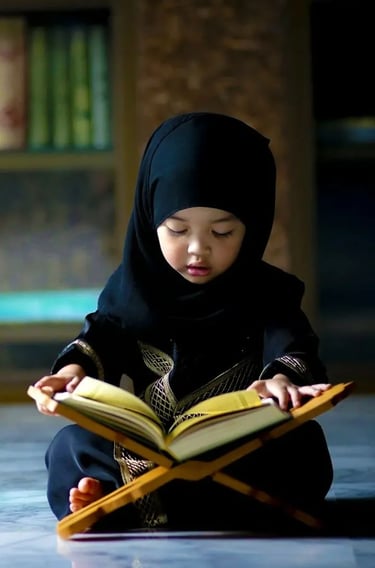
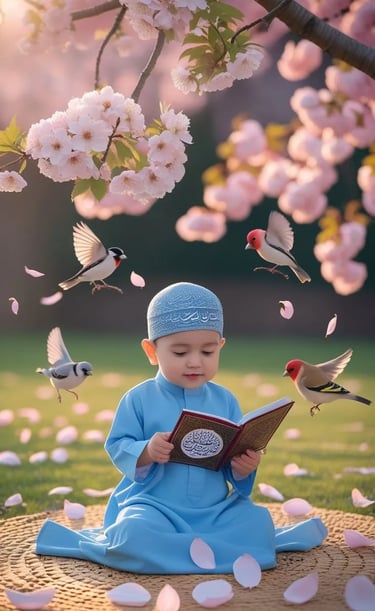
Which hadiths are linked to the Shahada regarding the first word a child pronounces?
✦
Hadith 1
“Open the speech of your children with:
‘Lā ilāha illā Allāh.’”
Reported by al-Ḥākim (whom he judged authentic according to his criteria, then re-examined by other scholars).
Context:
This statement is part of the teachings of the Prophet ﷺ Peace and blessings of Allah be upon him. on raising children.
It is not an imposed rite, but a spiritual orientation: that the first words a child hears and says be those of Oneness.
We allow ourselves a gentle touch of humor by saying that this avoids any competition over whether the child will say “mum” or “dad” first. It suggests a union rooted in a protective and pure love.
✦
Hadith 2
“Every child is born upon the fitra.
Then his parents make him a Jew, a Christian, or a Magian.”
(Bukhārī, Muslim)
Context:
Here, the Prophet ﷺ Peace and blessings of Allah be upon him, teaches that every human being is born with a natural disposition oriented toward Oneness.
It is then the environment that shapes belief.
This hadith clarifies the meaning of the first one:
the Shahada does not create faith; it awakens it.
In many Muslim families, it is common to hope that a child’s first words will be:
“Lā ilāha illā Allāh.”
This gesture is an expression of affectionate care, a way of surrounding birth with a gentle and benevolent reminder.
It does not constitute entering Islam in the religious sense.
The Shahada, as an act of faith, always remains a free, conscious, and personal choice.
It only takes on its full value when it is pronounced with understanding and heartfelt assent.
In the Islamic tradition, a child is not required to practice before the age of seven,
the age at which one begins to gently guide the child in learning actions and words.
These words whispered in early childhood are therefore not a constraint,
but a tender presence, a horizon placed with gentleness,
until, later on, each person can choose for themselves.
The first words

This naturally leads us to ask:
What is the fitra?
Fitra is an unconscious and natural predisposition to do good.
It is the original disposition with which every human being comes into the world:
an innate capacity to recognize the Creator, to seek meaning,
to love what is just, and to instinctively reject injustice.
It is not learned knowledge, nor a formulated faith,
but an inner inclination toward what is right.
The Prophet ﷺ Peace and blessings of Allah be upon him, does not say that a child “is born Muslim” in the legal sense,
but that he or she is born upon the fitra—that is, in a state of pure receptivity to truth.
It is then the environment, culture, education, and the words one hears
that orient this nature in a particular direction.
In this way, fitra can also be seen in spontaneous kindness toward others.
To illustrate this simply, let us take a concrete example:
A person may, by nature, be respectful toward their parents,
feel compassion for the poor,
show care for orphans, neighbors, and people in difficulty,
without knowing that this has anything to do with Islam.
Then, one day, they read in the Qur’an:
«“And your Lord has decreed that you worship none but Him, and that you show kindness to parents.
If one or both of them reach old age with you, do not say to them ‘Uff,’
nor repel them, but speak to them graciously.
And lower to them the wing of humility out of mercy and say:
‘My Lord, have mercy upon them as they raised me when I was small.’”
(Surah al-Isrā’, 17:23–24)»
And also:
«“Worship Allah and associate nothing with Him.
And show kindness to parents, relatives, orphans, the poor,
the near neighbor, the distant neighbor, the companion at your side,
the traveler in need, and those whom your right hands possess.”
(Surah an-Nisā’, 4:36)»
Then:
«“As for the one who gives and is mindful of Allah,
and affirms the best reward,
We will ease him toward ease.”
(Surah al-Layl, 92:5–7)»
At that moment, the person recognizes in these words what they already carried within.
They understand that what they were doing naturally—through fitra—
corresponds to the revealed truth.
It confirms it, illuminates it, and gives it meaning.
✦
Invocation (Dua)
O Allah, You who created hearts upon the fitra,
preserve within us this original disposition toward truth.
Make what we have read here a light for us,
a gentle reminder of Your Oneness,
and a cause of uprightness in our words and in our choices.
Grant us to recognize the truth when it appears
and to follow it with sincerity.
Protect our children,
preserve their hearts,
and grant them the best in this life and in the Hereafter.
Āmīn
Proposed caption for this image Verses 27 and 28 of Surah Fāṭir (35)○ “Have you not seen that Allah sends down water from the sky, by which We bring forth fruits of various colors? And among the mountains are streaks white and red, of different shades, and others intensely black.”,(Surah Fāṭir, 35:27)○ “Likewise, among people, animals, and livestock are various colors. Only those of His servants who have knowledge truly fear Allah. Allah is Mighty and Forgiving.” (Surah Fāṭir, 35:28)= no racism.
What is the meaning of fitra?
Navigation Help
You can click on each image below to explore the different pages.
Say BismiLlāh and enjoy the journey.









The First Words
The forms of the Shahada
The index finger in the Shahada
The Shahada in the Qur’an
Entering Islam
The Shahada in Prayer
In the believer’s life
Sincerity of the Heart
Miracle
The supreme rank of the Shahada


The Forms of the Tashahhud in Prayer


Purification : Ablution


The Shahada in the Call to Prayer


Prayer
Time
Home




The Last Word

